
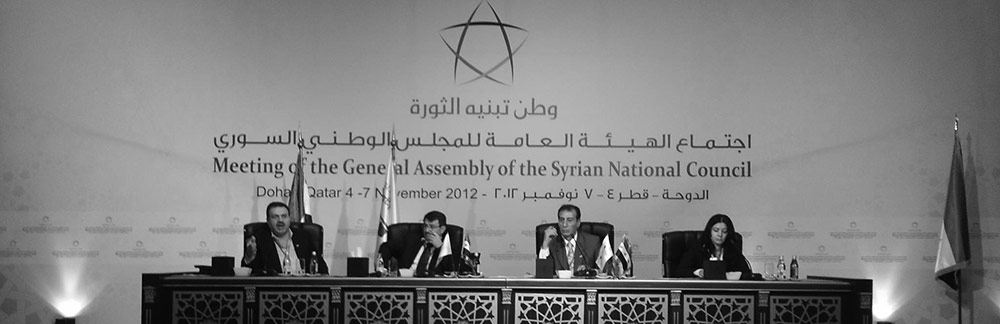
Information on the SNC
Introduction
The Syrian Revolution is nearing its fifth anniversary and has yet to achieve a political solution due to the dual-veto wielding power of Russia and China in the United Nations Security Council. This coalition plans to create real solutions to alleviate the suffering of the Syrian people and present political and economic support to the Syrian National Council (SNC).
The Idea
In the wake of the Russian-Chinese veto in the Security Council, and given the Assad regime's continued murder of and brutal attacks on civilians, the United States and France launched the idea of forming a coalition of "Friends of Syria." The Arab League, with the specific endorsement of Saudi Arabia and Qatar, supports this idea. The SNC supports the idea of calling on Syrian nationals to accelerate the work of "Friends of Syria" because the massacres and killing continue to take place all over Syria.
Tunisia to Host
Tunisia agreed to host the "Friends of Syria" conference to create alternative solutions to assist the Syrian people. In this context, the Rafik Abdulsalam, the Tunisian Minister of Foreign Affairs indicated that the February 24 conference, titled "the Conference of Friends of the Syrian People," would include foreign ministers from the Arab League, the European Union, the Organization of the Islamic Conference, and several international stakeholders, including the United States, China, Russia, India and Brazil.
Russia will not Attend
Russia announced that it would not attend the "Friends of Syria" conference, indicating that the call did not go to supporters of the Syrian regime, which Russia considers "bias of one side against the other in an internal conflict." In an important new development, the Chinese government indicated that it was considering attending the conference.
Lebanon will Boycott
Lebanon decided to boycott the "Friends of Syria" conference, because of their initial position on the Syrian Revolution. The Syrian regime plays an important role in influencing the agenda of several political blocs and parties in Lebanon.
Support of the Arab League
The Arab League has been at the forefront of the regional initiative to end 11 months of bloodshed in Syria. In January, when it became clear to the Arab League that the Assad regime failed to respect the terms of any agreement, and continued to kill civilians, it decided to withdraw the observers and abort their mission, calling upon the United Nations to send peacekeeping forces to Syria, impose a diplomatic boycott, enact additional economic sanctions, and support the Syrian opposition. After the UNSC veto by Russia and China, the idea of the “Friends of Syria” coalition was introduced by several countries including Saudi Arabia, Qatar, France, United States and the United Kingdom.
The Syrian National Council
The SNC will present its plans and vision of the post-Assad era, and intends to renew its call for the establishment of humanitarian corridors that would permit relief organizations to enter the disaster-stricken areas, and the adoption of the Arab League initiative. The following is the text of the SNC official statement presented to the Friends of Syria Conference.
The Friends of Syria Meeting in 2012
The struggle of the Syrian people for freedom, equal citizenship and democracy has the support of a large majority of the international community. The passage with an overwhelming majority last week of the UNGA resolution condemning the Syrian Government’s violations of human rights and freedom, and demanding it to end the violence. The resolution also called for an inclusive Syrian-led political process. While this reflects the solid international consensus in support of the Syrian people’s struggle, the UN Security Council has failed so far to translate this consensus into a common will to act. The Friends of Syria meeting takes place in the aftermath of the UN votes and the Syrian people put high hopes on this coalition.
The Syrian people have so far fallen victims of strategic rivalries between regional and international powers on one hand, and victims of the two precedents in the Arab uprisings, Libya and Yemen. But Syria is neither Libya nor Yemen. The Syrian National Council does not seek regime change at the hands of foreign powers as in Libya. But the criminal repression and the dire humanitarian situation in Syria cannot be allowed to continue for weeks and months while a political arrangement is brokered as was the case in Yemen. The level of killing and the atrocities perpetrated by the regime are much higher and are unbearable.
The SNC is participating in the Friends of Syria (FoS) meeting in Tunis on February 24 as the representative of the Syrian people. The SNC pursues two tracks: it seeks immediate humanitarian assistance on one hand, and a political process to achieve a peaceful and orderly transition on the other hand.
1- International assistance to respond to the facts on the ground, specifically humanitarian assistance and safe havens inside Syria
Regarding Humanitarian Assistance: We seek immediate supply of humanitarian assistance to the most affected areas by creating safe passages for humanitarian convoys. The Arab League and other friendly countries should seek Russia’s cooperation to secure a commitment from the Syrian regime that its security and military forces will allow the safe access of convoys, thus reducing the need to militarize those passages.
Regarding Safe Zones: We urge the Friends of Syria to take additional steps to safeguard the Syrian people by creating safe zones in border areas and protecting the Syrian refugees who seek sanctuary there. Creation of secure safe zones will allow us to work more closely with internal activists, strengthening coordination and building unity of action. Safe zones should be established in areas accessible to citizens in the north, south and eastern areas of Syria. These zones could also be used as bases of operations for humanitarian relief delivery operations.
2- Seeking support for a two-fold strategy
- Strengthening the peaceful nature of the revolt on the ground through: the SNC seeks all possible support for its strategy aimed at a) establishing local councils in different regions of the country to support the civilian population and provide the networks for channeling assistance now and preserving civil society for the future, b) mobilizing hitherto reluctant groups to support the revolt, and c) encouraging defections of businessmen who supported the regime so far, technocrats and civil servants.
- Supporting the Free Syrian Army and all forms of popular Resistance: Understanding and supporting the desire to depose the Assad regime through non-violent means, the Syrian people have the right to protect themselves and their communities. If the regime fails to accept the terms of political initiative outlined by the Arab League and end violence against citizens, the Friends of Syria should not constrain individual countries from aiding the Syrian Opposition by means of military advisers, training and provision of arms to defend themselves.
3- The establishment of an international fund with pledges from Arab and friendly states for food, shelter and medical supplies. But funds as medical aid are useless without a mechanism for delivery. Hence the need for safe passages.
4- Recognition of the SNC as the legitimate representative of the Syrian people
The SNC seeks international recognition as the legitimate representative of the Syrian people. The SNC was created in October 2011 as a coalition combining representatives from a broad range of local coordination committees of the movement on the ground, existing political groups and ethnic/religious groups. These are all represented in the three bodies of the Council: the Executive Bureau, the General Secretariat and the General Assembly. Groups who joined the coalition committed to a set of common principles notably the fall of the Assad regime with all its repressive institutions beginning with the head of the State.
Since its creation, the SNC has worked relentlessly to integrate new members and expanded its institutions to ensure fair representation of the revolutionaries on the ground, of old and newly formed political groups, ethnic and religious minorities and independent public figures. The leadership of the SNC continues to negotiate with different groups to enhance the representation of all components of Syrian society and of political movements.
It should be noted that while inclusion is the overriding principle of the SNC for all groups who share the Council’s main objectives, the expansion of the various representative bodies represents a challenge at the organizational and functional levels. The SNC is working with a number of friendly countries and NGOs to reconcile representation and efficiency.
5- Ensuring Border Security
The Syrian people reject all attempts to exploit the uprising by foreign Jihadi and sectarian fighters. The SNC requests the Friends of Syria assistance to help neighboring states secure their land borders with Syria to stem the flow of unwanted foreign fighters. We also request that the FoS help secure the maritime border so that fighters and weapons cannot be delivered by sea. Egypt should restrict access to the Suez Canal of ships carrying weapons to the Syrian regime. FoS countries should refuse to provide port services to Russian ships suspected of carrying weapons to the regime.
6- Starting a Political Transition Plan
Negotiation with the goal of Regime Change: The SNC sees that a political negotiation with the acceptable members of the Syrian government is still possible and is likely the best way to achieve the desired goal of regime change. The SNC will therefore continue to seek Russia’s cooperation to press the regime for stopping the repression so a ceasefire can be reached.
Negotiation with acceptable members of the regime is possible so long as it is understood that the goal of any such negotiation is government change under the condition that no negotiation should take place until a full cease fire is in place, the killing has stopped, and prisoners have been released. By acceptable, we mean regime figures who do not have blood on their hands and who may be allowed to remain during a transitional period.
The clear goal of the SNC and one for which tens of thousands of Syrians have died or suffered is to achieve full regime change through a process controlled by the Syrians themselves.
The SNC seeks a negotiated peaceful transition of power and the implementation of the Arab League plan opening the way for negotiations. The SNC believes that the implementation of the transition period will only succeed if the head of the regime steps down and key figures directly responsible for ordering major crimes are removed from their positions.
The primary task of a unity government will be to restructure the security apparatus of the country, to revise the constitution, and to restructure government institutions so they continue to serve the people during the transition.
The Syrian people want justice but what they want first and foremost is an end to the bloodshed and the preservation of the Syrian state in its integrity and its institutions.
Syrians have a right to know the full truth about the crimes of the Assad regime over forty years. The SNC will seek to implement a transitional justice plan that provides a mechanism for truth and reconciliation. But the key figures of the regime responsible for the crimes will never be tolerated as part of any transitional process.
The SNC is ready to name by name the members of the Al Assad clan and any close affiliates who will be expected to depart within a set time frame. Other figures from the regime can be named who will be expected to be removed from their positions but be allowed to remain in the country. Immunity from prosecution could be considered for key regime figures so long as they stay away from Syria and commit not to ever interfere in its internal politics. Any violation of this pledge will result in immediate prosecution.
A Presidential council will be formed in the transition phase and will be responsible for all affairs related to sovereignty. A national unity transition government will be formed led by a figure from the opposition designated by the Presidential Council and will include members from the regime who have no responsibility in crimes or major corruption affairs, opposition figures and representatives of the revolutionary committees.
The transition government will oversee the organization of elections for the designation of a Constituent Assembly. The responsibility of the Constituent Assembly will be to draft a new constitution, a political party law and a new election law and oversee the holding of parliamentary and presidential elections to be held within a period to be defined (12 to 18 months). State institutions will undergo a restructuring scheme with changes in their management to make them more transparent and accountable in their work.
7- Diversity and Minorities
The SNC has clearly stated in its political program that it sees no future for any of the components of Syrian society without the necessary guarantees given to the ethnic (Kurds, Assyrians, and others) religious (Christians, Alawites, Druze, and others) minorities : provisions for their safety and well-being, respect for their rights in the Constitution, laws and public policies. A democratic Syria will be as much about the protection of and respect for minorities’ rights as it will be about the expression of the will of the majority. The program of the SNC outlines a consensual vision among the different member groups of the Council for a democratic Syria based on principles of equal rights for all citizens and the respect, protection and promotion of minorities’ rights.
Given the evil attempts by the regime to tear the social fabric apart and to make the Alawite community hostage to its strategy, the SNC will ensure that the planned dispositions to maintain order in the immediate aftermath of the fall of the regime and to organize the army and security forces includes measures to guarantee the safety of the community.